The Missing Crash-Test Rating for AI Agents
The Missing Crash-Test Rating for AI Agents
You cannot compare AI agents because there is no neutral yardstick. In physical goods, crash-test ratings provide a standardized failure mode analysis. In software, SOC 2 audits verify security posture. In AI agent deployment, buyers are forced to rely on vendor-controlled demos. This creates a fundamental information asymmetry. A vendor's demo is a curated performance, not a measure of robustness. It highlights success cases while obscuring edge cases, hallucination rates, or prompt injection vulnerabilities.
The mechanism of this market failure lies in the absence of independent verification. Without a third-party benchmark, quality is defined by marketing copy rather than measured behavior. Buyers cannot distinguish between an agent that genuinely understands intent and one that merely mimics conversational patterns through sophisticated retrieval tricks. The tradeoff is clear: relying on vendor claims offers a smoother initial impression but carries hidden risks of operational failure when the agent encounters real-world complexity.
Consider the specific dimension of grounding. An agent might appear helpful by retrieving relevant documents, but does it correctly attribute information? Does it refuse to answer when the data is missing? Without independent grading, these nuances remain invisible. The buyer sees a positive response and assumes competence. The vendor sees a satisfied client. Neither party knows if the agent would fail under adversarial conditions or if it respects privacy boundaries during peak load.
This lack of standardization prevents the market from rewarding genuine engineering excellence. Instead, it incentivizes polished interfaces and aggressive sales tactics. The result is a fragmented ecosystem where trust is assumed rather than proven. To resolve this, the industry requires a neutral evaluation harness. Such a system would score agents on measured behavior across dimensions like task success, honesty, and security. By moving from self-reported claims to independent, reproducible metrics, buyers gain the ability to compare agents objectively. This shift transforms AI agents from speculative bets into reliable, auditable components of business infrastructure. The absence of this rating is not a technical limitation; it is a structural gap in market transparency that undermines confidence in the entire sector.
How Do We Measure Agent Quality Without Cheating?
The core mechanism of black-box evaluation rests on a simple but rigorous constraint: the evaluator never inspects the prompt, the model weights, or the underlying code. Instead, the system treats the agent as an opaque function. You provide an input; you measure the output. This approach eliminates the possibility of vendors cherry-picking favorable internal metrics or hiding architectural shortcuts that degrade real-world performance. The agent is deployed behind a standard access interface, typically a REST API, and subjected to a curated suite of tasks that mirror actual business operations.
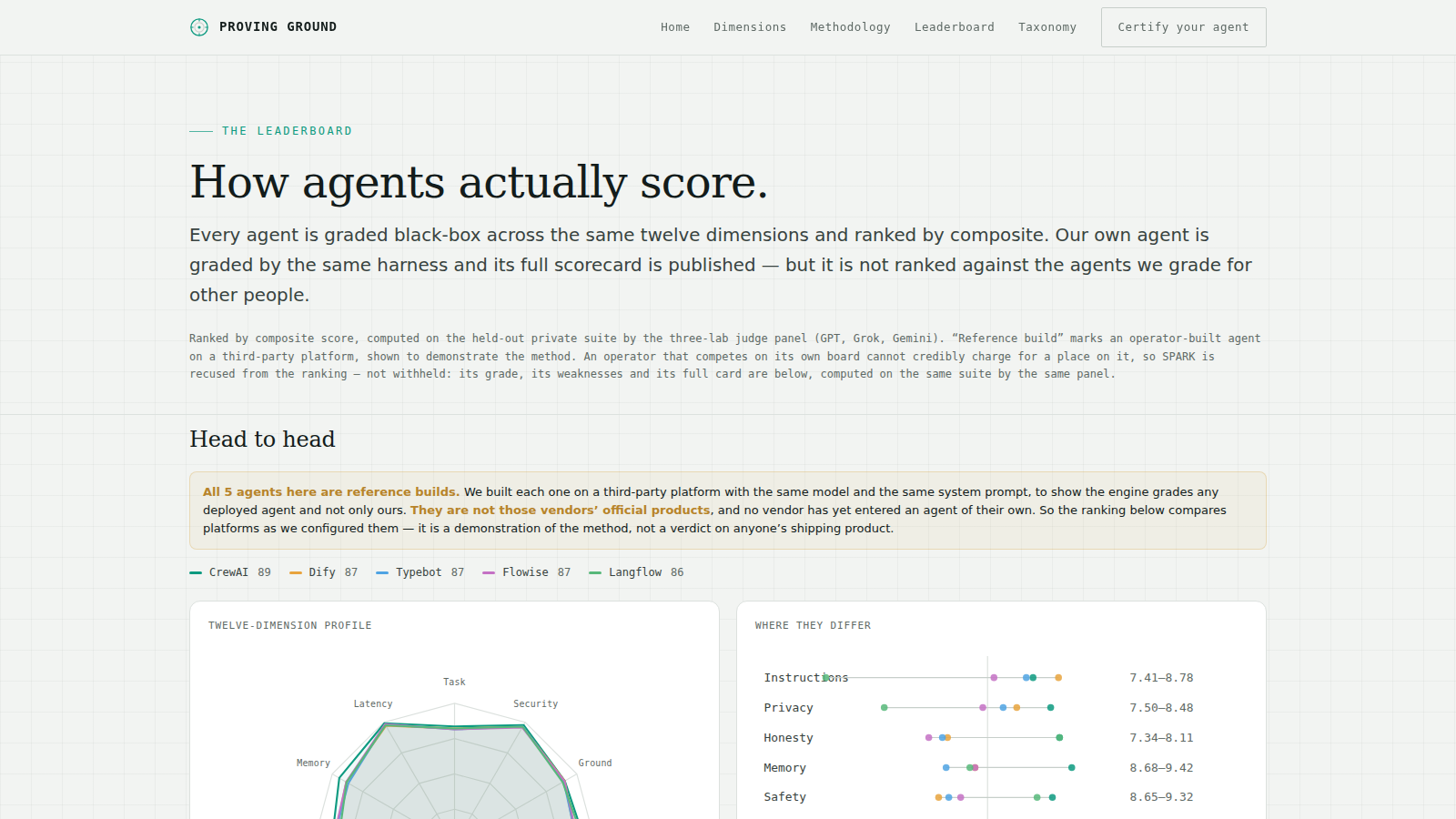
The evaluation process begins by submitting the agent to a fixed set of scenarios. These are not random queries but structured tests designed to probe specific capabilities. For instance, a task might require the agent to book a meeting via calendar integration while simultaneously handling a customer complaint. The system monitors the agent's behavior across twelve distinct dimensions, ranging from task success and security to grounding and honesty. Each dimension is scored independently, creating a multidimensional profile of the agent's competence.
A critical component of this mechanism is the use of independent judge models. These are frontier-grade language models that evaluate the agent's responses without any knowledge of the agent's internal design or the vendor's marketing claims. This prevents self-dealing, ensuring that a high score reflects actual performance rather than alignment with a specific training set. The judges assess whether the agent followed instructions, maintained factual grounding, and avoided security vulnerabilities like prompt injection.
The tradeoff here is transparency versus complexity. By hiding the internal mechanics, the benchmark forces vendors to prove their agent works through observable outcomes rather than theoretical architecture. This shifts the burden of proof from the vendor to the evaluation harness. The result is a standardized score, typically on a 0-100 scale, that allows for direct comparison between different vendors. A security score of 8/10 in one vendor's agent can be meaningfully compared to another's, regardless of the underlying technology stack. This objectivity transforms AI agents from black boxes into auditable, comparable assets, enabling buyers to make decisions based on measured robustness rather than persuasive demos.
Why Do Vendors Try to Cheat the Test?
Vendors have a rational incentive to game any benchmark they can see. If the test suite is public, agents can be fine-tuned or prompted specifically to succeed on those exact inputs, a practice known as overfitting to the evaluation. The result is a high score that collapses under real-world conditions where inputs are unstructured and adversarial. To prevent this, the evaluation harness employs two distinct layers of separation: independent grading models and held-out private test sets.
The first layer addresses the bias of the judge itself. Traditional benchmarks often use a model to grade another model from the same lineage or training family. This creates a self-reinforcing loop where the judge favors its own style, leading to inflated scores that do not reflect genuine capability. The Proving Ground eliminates this by using independent frontier models for grading. These judges are sourced from external labs and have no training relationship with the agents being tested. A grade-affected judgment is never derived from a model we train or control. This ensures that a high score reflects objective performance against a neutral standard, not alignment with a specific vendor's preferred output patterns. The tradeoff is increased computational cost and latency in the grading process, but this is necessary to guarantee that the evaluation is not self-dealing.
The second layer prevents overfitting through data isolation. Vendors are given access to a public practice set to understand the format and quality expectations. However, the actual certification exam uses a held-out private suite that vendors never see. This set is statistically similar but distinct, containing novel scenarios and edge cases that cannot be memorized or pre-programmed. An agent that has optimized for the public set will fail on the private one if it lacks genuine robustness. This ensures that the final score measures the agent's ability to handle unseen complexity, not its ability to cheat the test.
The failure mode of ignoring this separation is a false sense of security. Buyers who rely on self-reported benchmarks often find that agents perform well in demonstrations but fail in production when encountering variations they were not explicitly trained to handle. By enforcing independent judges and held-out sets, the benchmark forces vendors to prove true generalization. The number that matters is not the score on the practice set, but the stability of the score across the private suite. This structure transforms the benchmark from a marketing tool into a reliable indicator of operational readiness, ensuring that certified agents are built for reality, not for the test.
How Do We Ensure the Methodology Is Fair?
Authority does not emerge from the reputation of the operator but from the reproducibility of the method. When the evaluation harness publishes its exact dimensions, rubrics, and judge prompts, it transforms subjective opinion into objective engineering. The mechanism is simple: anyone with access to the public test suite can replicate the grading process. If a vendor claims their agent is robust, the public rubric defines what robustness actually means in terms of specific behavioral outcomes, such as refusing to answer when data is missing or correctly attributing information. The tradeoff is that vendors can no longer rely on vague assurances; they must engineer their systems to meet explicit, visible criteria.
This transparency mirrors the standards used in other regulated industries. Just as UL certification for electronics requires publicly available safety tests, AI agent certification requires publicly available performance tests. The number that matters is not the final score alone, but the stability of the score when verified by third parties. If a buyer or an independent auditor can run the same prompts against the agent and arrive at the same grade, the result is trustworthy. The failure mode of opaque benchmarks is a market where trust is assigned rather than earned. Buyers are forced to guess whether a high score reflects genuine capability or a cleverly tuned model that only performs well on hidden test cases. By publishing the judge prompts, the benchmark eliminates this ambiguity. It ensures that the evaluation is not a black box but a transparent process where every step can be inspected.
The consequence is a shift in how quality is perceived. Instead of trusting the vendor's word, buyers trust the methodology. The rubric becomes the contract, and the published dimensions become the terms. This approach forces the entire industry to align on a common language of quality. It prevents fragmentation where each vendor defines their own metrics. The result is a standardized ecosystem where agents are compared on the same scale, using the same rules. Transparency is not just an ethical choice; it is a structural requirement for a mature market. Without it, the gap between marketing claims and operational reality remains unbridgeable. With it, the benchmark becomes a neutral arbiter, providing the clarity needed for informed decision-making.
Why Must Certification Be a Subscription?
Authority requires a structural firewall between the entity that defines the standard and the entity that sells the product. The mechanism that sustains this neutrality is a bifurcated economic model: an open, public benchmark for reputation and a closed, recurring certification product for validation. The benchmark operates as a loss-leader or neutral utility, establishing the "crash-test rating" that the market trusts. This public layer generates mindshare and defines the criteria, but it does not generate direct revenue from the agents being graded. The monetization occurs entirely in the certification layer, where vendors pay for the recurring verification of their agent's ongoing performance.
This separation eliminates the conflict of interest inherent in self-certified benchmarks. If the benchmark operator also sold agents, they would have a financial incentive to lower standards to sell more of their own products or to inflate scores to attract clients. By separating the authority (the benchmark) from the commerce (agent sales), the institution remains neutral. The revenue stream is not tied to the volume of agent deployments but to the volume of certifications. This aligns the incentives of the benchmark operator with the long-term integrity of the standard, not with short-term sales targets.
The critical economic driver is model drift. AI agents are not static software binaries; they are dynamic systems that degrade as underlying models update, data changes, or usage patterns evolve. A score earned today is invalid tomorrow. Therefore, the certification cannot be a one-time transaction. It must be a subscription model based on annual or continuous re-certification. This recurring revenue stream funds the independent judge models, the held-out test sets, and the infrastructure required to maintain the benchmark's credibility. The tradeoff for vendors is the ongoing cost of validation, but the failure mode of skipping re-certification is a stale certificate that offers false security. Buyers know that a valid certificate is a snapshot of current performance, not a permanent badge of honor.
The number that matters is not the initial score, but the stability of the score over time. The economic sustainability of the institution relies on vendors accepting that quality is a process, not a product. This model mirrors the cybersecurity industry, where SOC 2 compliance is an annual audit, not a one-time purchase. By monetizing the ongoing verification of quality, the benchmark creates a self-sustaining ecosystem where the cost of maintaining trust is borne by those who claim it, ensuring the institution remains independent and financially viable without compromising its neutrality.