What Breaks When a Bilingual Caller Meets a Language Menu
What Breaks When a Bilingual Caller Meets a Language Menu
When a caller switches languages mid-sentence, the voice agent's performance and the customer experience take a hit. Why? A language menu treats language as a property of the call, not the sentence. The caller makes one choice at the start, and the system routes to a queue staffed for that language. This works for a caller who lives in one language but fails for a caller who moves between two. For them, language belongs to the sentence, not the call.
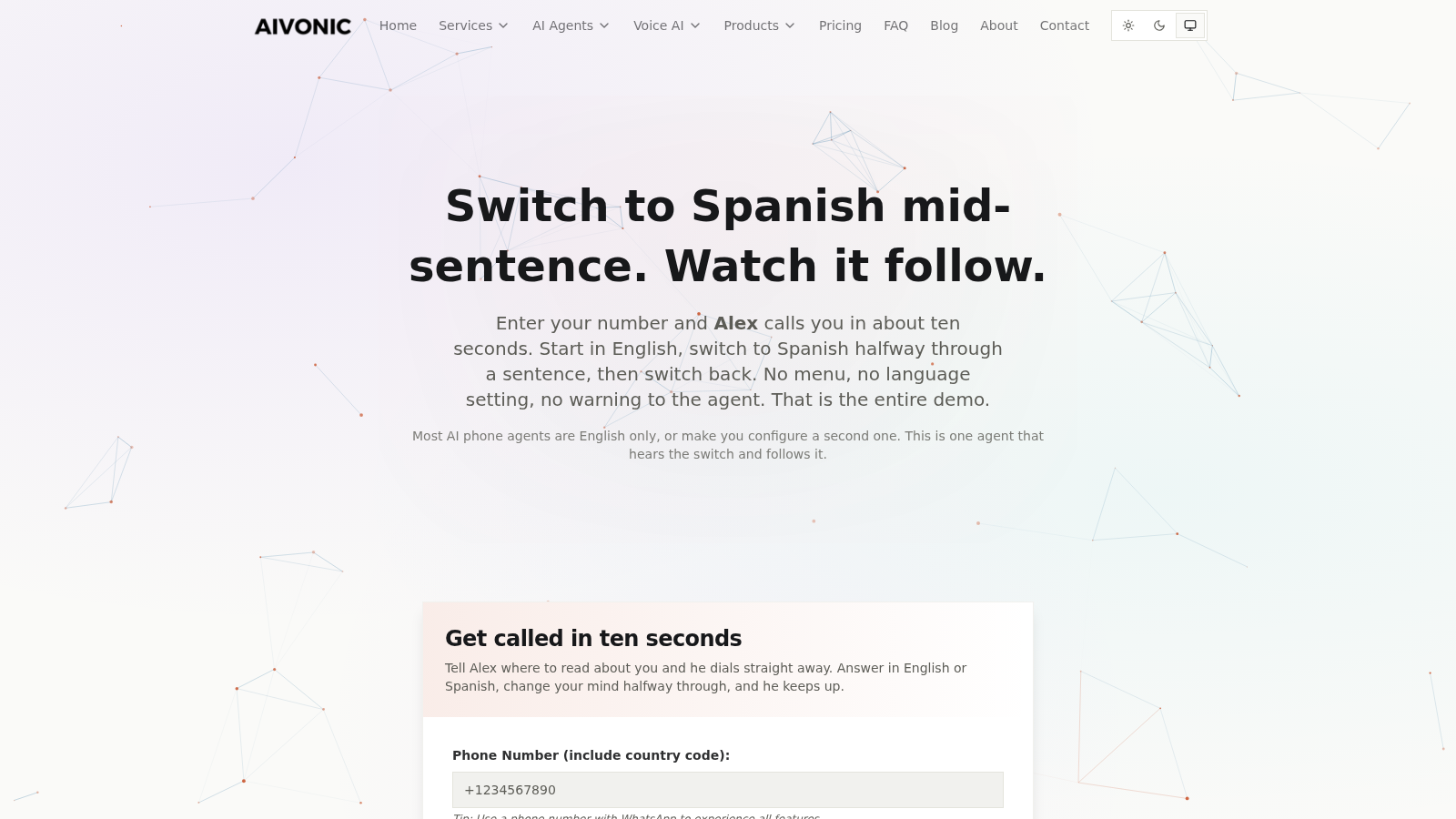
A single agent that detects language on each turn and keeps one shared context for the whole call never has to hand anything off. A switch mid-sentence becomes the next turn, answered in the language it was spoken in, with everything said so far still in view. This is how Aivonic Labs' agents are designed to handle language switches seamlessly.
How One Agent Follows a Language Switch, and Where It Can Lose the Thread
The pipeline runs once per turn. Capture comes first. The agent listens until it hears a silence boundary and treats that as the end of the turn. If the caller starts talking while the agent is speaking, the agent stops at once. The captured audio is then transcribed, and a language detector scores the turn to decide what was spoken. That label and the text join a single running history, so the reasoning step reads an English address and a Spanish complaint as parts of one problem. Last, a selection rule picks the reply language, and synthesis uses the voice matched to that language.
Each step has a weak spot. Detection needs signal, and short utterances carry very little. A detector that flips on every one-word turn makes the agent bounce between languages. A safer rule holds the current language until a turn contains enough words to justify a change.
Names, product terms, and loanwords cause the opposite problem. A Spanish sentence containing "refund" and a brand name can look English to a detector weighing tokens. The transcriber may also mangle a surname that belongs cleanly to neither language.
Mixed sentences raise a policy question rather than a technical one. If a caller starts in English and ends in Spanish, the agent can mirror the last language heard or the one that dominated the turn. Mirroring feels responsive but can chase a single trailing phrase. Dominance is more stable but can override a deliberate switch.
Edge cases worth probing:
- one-word answers right after a switch
- names and account numbers spelled aloud
- product names embedded in the other language
- a switch halfway through one sentence
- a switch, then a switch back
- barge-in during a reply in the old language
The Latency Budget: Where the Pause Comes From and What Switching Adds
The gap a caller hears runs from the moment they stop talking to the first audible syllable of the reply. Four stages sit inside it. Endpointing waits for enough silence to be confident the turn is over. That wait is usually the largest single piece, because shortening it means cutting off callers who pause mid-thought. Transcription follows. With streaming recognition, most of it overlaps the caller's speech, leaving only the final words to finish. Reasoning comes next: the model reads the history and drafts a reply, and any tool lookup, such as an order query, adds time here. Synthesis closes the gap, and what counts is time to first audio, not time to render the whole sentence.
Language handling touches two of these stages, and only lightly. Detection runs on the transcript already produced, so it adds a scoring pass rather than a new round trip. Switching voices adds little if every language's voice is ready before the call starts, and more if a voice must load on the first switch. Endpointing and reasoning do not change. A transfer adds hold time, a fresh greeting and a recap of everything already said. That cost is measured in minutes of conversation, not fractions of a second.
Barge-in has its own clock: how long the agent keeps talking after the caller starts. To stop, the agent must hear the caller over its own audio, cancel synthesis already queued and discard the stale reply.
To measure, record real calls with both channels and timestamp the end of caller speech and the start of agent audio for every turn. Report the median and the slow tail separately. Split out turns with tool calls, and compare same-language turns against turns right after a switch. Vendor figures often time one stage in isolation.
Naturalness Across Languages: Keeping One Voice When the Language Changes
A caller judges identity from a few cues: pitch range, speaking rate, warmth, and how the agent addresses them. If the English voice is calm and low-pitched and the Spanish voice is bright and quick, the switch sounds like a handoff even though none happened. Persona has to carry across as well. Register should map on purpose. An agent that has been using a caller's first name in English should not jump to a stiff, formal Spanish without a reason. Consistency across languages is crucial for maintaining the illusion of a single, coherent agent.
To ensure naturalness and consistency, the agent must:
- Use consistent voice characteristics across language switches.
- Maintain a consistent persona and address the caller appropriately.
- Handle mixed sentences and loanwords accurately.
- Address policy questions about language dominance and mirroring.
- Probe and refine strategies for handling specific edge cases.
By addressing these challenges, Aivonic Labs' agents can provide a more seamless and natural experience for multilingual callers, enhancing customer satisfaction and operational efficiency.
Conclusion: The Path to Seamless Multilingual Conversations
Seamless multilingual conversations are not just about language detection and voice synthesis; they are about maintaining a coherent and natural experience for the caller. By focusing on naturalness, consistency, and the policy questions that arise from language switches, Aivonic Labs' agents can provide a superior experience for callers and businesses alike. The future of voice agents lies in their ability to handle the complexity of human communication with grace and efficiency.